five Operational Mistakes That Reduce the Profitability of Car Washes and Detailing Centers in Saudi Arabia
Introduction
The Automotive Aftermarket sector in Saudi Arabia is experiencing rapid growth, driven by the increasing number of vehicles, growing awareness of the importance of vehicle maintenance and care, and the continuous expansion of specialized automotive services.
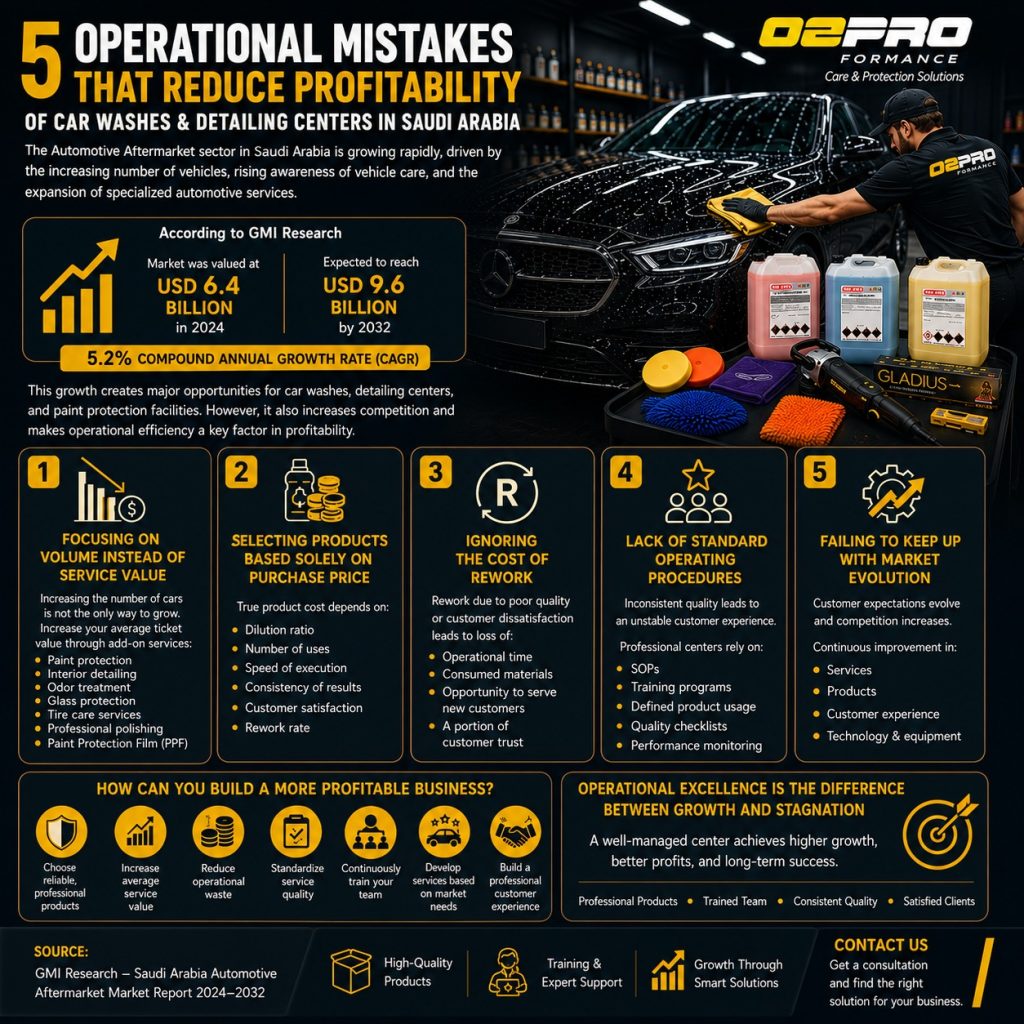
According to a report by GMI Research, the Saudi Automotive Aftermarket market was valued at approximately USD 6.4 billion in 2024 and is projected to reach USD 9.6 billion by 2032, growing at a compound annual growth rate (CAGR) of 5.2%.
This growth presents significant opportunities for car washes, detailing centers, and paint protection facilities. However, it also increases competition and makes operational efficiency a critical factor in achieving profitability and long-term sustainability.
Despite the growing demand for vehicle care services, many businesses continue to lose a portion of their profits due to daily operational mistakes that may not be clearly reflected in financial reports, yet directly impact service quality, customer satisfaction, and profit margins.
Mistake #1: Focusing on the Number of Vehicles Instead of Service Value
Some car wash owners believe that increasing the number of vehicles serviced each day is the fastest way to boost revenue.
In reality, the most successful businesses do not rely solely on volume. Instead, they focus on increasing the average ticket value by offering value-added services such as:
Paint protection.
Professional interior detailing.
Odor treatment.
Glass protection.
Tire care services.
Professional polishing.
Paint Protection Film (PPF).
The higher the value of the services provided per vehicle, the greater the revenue generated without increasing pressure on the team or expanding operational capacity.
Mistake #2: Selecting Products Based Solely on Purchase Price
One of the most common mistakes is evaluating products based only on the purchase price of the container or package.
In reality, the true cost of a product should be assessed based on several factors, including:
Dilution ratio.
Number of applications.
Speed of execution.
Consistency of results.
Customer satisfaction.
Rework rate.
A lower-priced product may initially appear to be the more economical option, but it can lead to higher consumption, lower-quality results, and increased customer complaints.
Professional-grade products designed for commercial use help reduce waste and deliver consistent results, ultimately improving operational efficiency over the long term.
Mistake #3: Ignoring the Cost of Rework
Rework caused by poor quality or customer dissatisfaction represents one of the largest hidden costs in the service industry.
When a technician is required to repeat part of a service, the business loses:
Operational time.
Consumed materials.
The opportunity to serve a new customer.
A portion of the customer’s trust.
Although these costs often do not appear as a separate item in financial reports, their direct impact on profitability can be substantial, especially when they occur on a daily basis.
Mistake #4: Lack of Standard Operating Procedures
In some facilities, service quality varies from one technician to another despite using the same equipment and products.
This inconsistency creates an unstable customer experience and negatively affects the likelihood of repeat business.
For this reason, professional centers rely on:
Standard Operating Procedures (SOPs).
Regular training programs.
Defined product usage quantities.
Quality control checklists before vehicle delivery.
Continuous performance monitoring.
The goal is not simply to provide a good service, but to deliver the same level of quality every time.
Mistake #5: Failing to Keep Up with Market Evolution
According to GMI Research, the growth of Saudi Arabia’s Automotive Aftermarket sector is closely linked to the increasing number of vehicles leaving warranty coverage and the growing reliance on independent service providers outside dealership networks.
As customer expectations continue to evolve and competition intensifies, providing a traditional service alone is no longer enough.
Businesses that fail to continuously improve their services, products, and customer experience may find themselves unable to compete in the years ahead.
On the other hand, facilities that invest in training, professional-grade products, and modern technologies are better positioned to attract customers, retain them, and achieve sustainable growth.
How Can You Build a More Profitable Business?
Sustainable profitability does not depend solely on marketing efforts or geographic location.
Instead, it relies on a combination of integrated factors, including:
Selecting reliable professional-grade products.
Increasing average service value.
Reducing operational waste.
Standardizing service quality.
Continuously training the team.
Developing services in line with market needs.
Building a professional customer experience.
Businesses that successfully manage these elements collectively are better equipped to increase customer loyalty and achieve long-term growth.
Conclusion
The Automotive Aftermarket sector in Saudi Arabia continues to experience steady growth and promising opportunities for the years ahead.
However, capitalizing on these opportunities is not simply a matter of attracting more customers. It requires improving operational efficiency, enhancing service quality, and managing resources in a more professional manner.
In many cases, the difference between a business that achieves sustainable growth and one that struggles with declining profit margins lies in its ability to manage daily operational details and transform them into a genuine competitive advantage.